


When the Wedding Timeline Blows Up: A Guide for Event Professionals
Every wedding has a run-of-show. And every wedding, at some point, departs from it.
The ceremony runs long. The kitchen falls behind. The couple decides they want another hour of dancing. These aren't failures — they're the actual texture of wedding work. What separates a memorable event from a stressful one isn't whether the timeline held. It's whether the team knew what to do when it didn't.
When the Ceremony Runs Long
A ceremony that runs 30 to 45 minutes over is the most common timeline disruption in the business — and the one with the most downstream consequences. Guests finally arrive at cocktail hour, the kitchen has been holding appetizers past their window, and the bar has been open longer than planned.
The instinct is to compress cocktail hour to claw back time. Don't. Guests who've just sat through a long ceremony need to breathe. Cut cocktail hour short and you send an unsettled, slightly rushed room into dinner service — and that energy doesn't recover easily.
Pro Tip 1: Protect the cocktail hour. Let dinner flex. The moment you know the ceremony is running long, get on the phone with your kitchen contact. Find out what can hold and for how long. Then let cocktail hour run its course and absorb the delay somewhere less visible — a tighter transition to dinner, a compressed course, a shortened toast window. A 15-minute dinner delay is invisible to guests. A rushed cocktail hour is not.
When the Kitchen Falls Behind
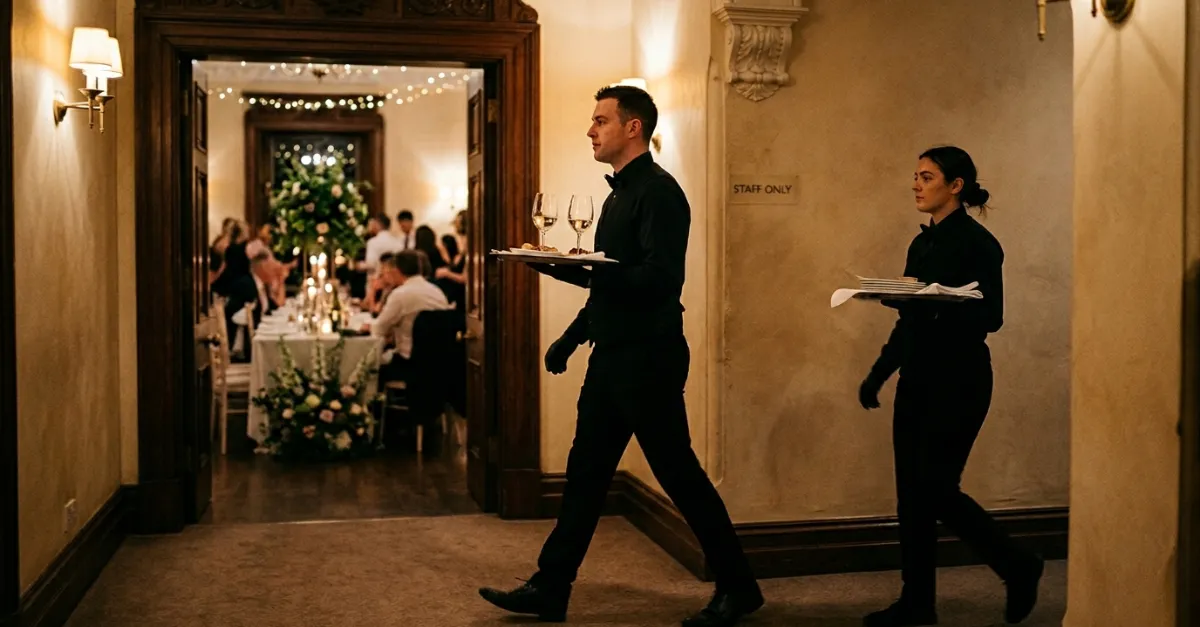
Tables are seated, guests are expecting food, and the kitchen isn't ready. This is where a lot of teams make the same mistake: the floor staff drifts toward the kitchen, waiting for the call. The room empties of visible presence. Guests notice.
The floor is exactly where your team needs to be. Water glasses filled, bread offered, warm conversation from your captain or a senior server. Visible, engaged, unhurried — that's what holds the room while the kitchen catches up.
Pro Tip 2: An empty floor during a hold is its own problem. A room full of attentive staff signals a well-run event even when the kitchen is behind. Assign someone — a captain, a senior server — to explicitly manage the hold: keep the team on the floor, keep guests attended to, and set a 10-minute check-in with the kitchen. Don't let the team cluster at the pass door. That's where confidence goes to die.
When the Timeline Compresses Mid-Event
Recovery from a delay often means compression somewhere else — toasts that need to move, a course that's getting cut, a dessert that becomes a pass-and-go instead of a plated moment. The service team has to shift gears mid-execution, which is exactly when clarity of leadership matters most.
Without someone explicitly calling the new plan, individual team members default to the original one — which is now wrong. The floor becomes inconsistent at the moment it needs to be sharpest.
Pro Tip 3: One person calls the pivot. Everyone else executes. This is not the moment for discussion. The floor captain or lead coordinator makes the call — "We're cutting the cheese course, moving straight to entrée on my signal" — and the team moves on it. Brief your staff before every event: when a pivot call comes, you execute first and ask questions after. A team that absorbs a change cleanly looks indistinguishable from a team that never had to change at all.
When the Couple Makes a Spontaneous Request
An extra hour of dancing. A surprise performance mid-reception. The cake now instead of in forty minutes. These requests feel small to the couple and immediately ripple into catering timelines, vendor contracts, and your team's scheduled end time.
The wrong move is saying yes before you've had thirty seconds to think. The right move is buying yourself sixty seconds — "Absolutely, let me make sure we can set that up perfectly" — stepping away, running the impact, and coming back with a yes and a clean plan.
Pro Tip 4: Build flex into your staffing plan so you can say yes. A team scheduled to the minute has no capacity to absorb a surprise. Staff transitions with a few minutes of overlap. Keep a floater without a fixed assignment for the first half of the event. Build in a buffer at the end. That buffer costs almost nothing in the budget and buys you the ability to handle the unexpected without it showing — which is the whole job.
The Through-Line
Experienced event professionals aren't valued because they prevent every problem. They're valued because their clients never knew a problem happened.
Every member of an FS Event Staffing team — from servers and bartenders to mixologists and floor staff — is trained for exactly this: not just to follow a plan, but to execute through one that's changed.
