


The Quiet Performance: The Art of Wedding Dinner Service
The Wedding Service Playbook — Part 3 of 4
The Wedding Service Playbook is a four-part series on the art of wedding service. This installment takes a deep dive into dinner service — the sustained performance at the heart of the evening.
If the cocktail hour is where the celebration opens, dinner service is its sustained performance. The room is set, the guests are seated, and for the next hour or so the service team is fully on — executing a live, time-sensitive operation with no pause button and no second takes. What makes dinner service feel effortless is rarely visible to guests. It lives in the decisions made before the first course is served, in the communication between the floor and the kitchen, and in the quiet authority of the person conducting it all.
The Captain as Conductor
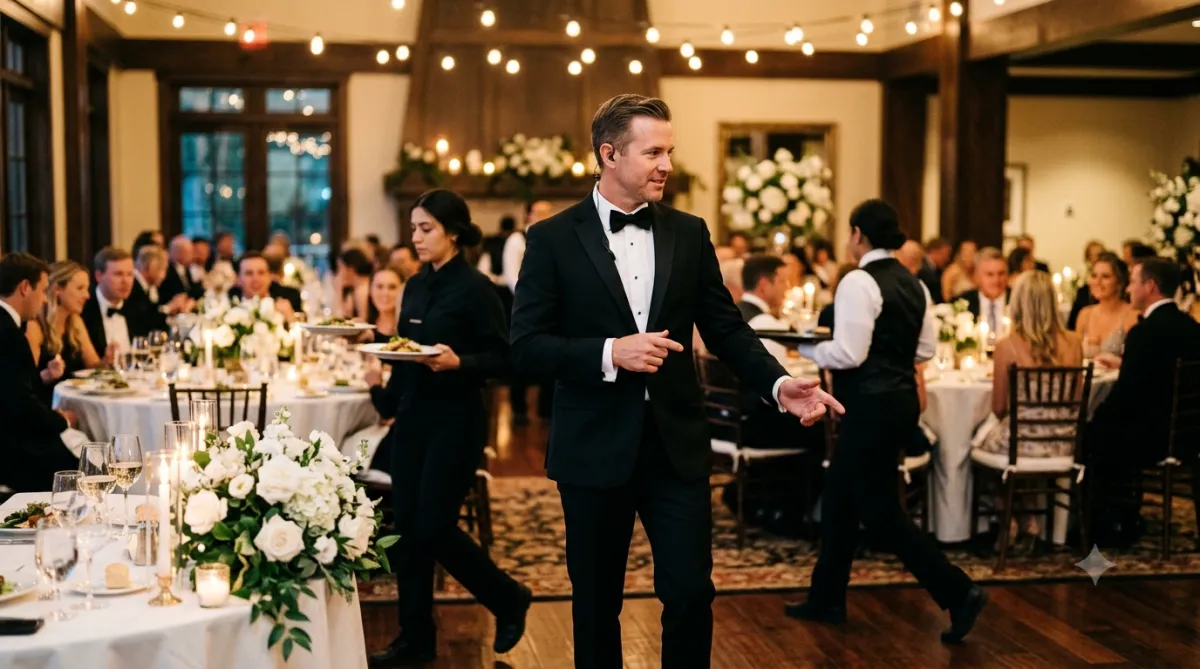
If there is one moment in a wedding where the captain structure becomes most apparent, it is dinner service — and yet, if the captains are doing it right, no one in the room will notice.
During the cocktail hour, the captain manages flow and energy — reading a moving room, timing the pass. Dinner service is different. The room is fixed, the guests are seated, and every course has to land at the right table, at the right moment, across the entire room simultaneously. The head captain sets the tempo — floor captains manage the dining room, the kitchen captain maintains the beat with the culinary team — and the whole team follows the lead — and when everyone is playing in sync, the guests experience something that feels effortless. A flawless performance, delivered by people they'll never think to notice.
When something shifts — a table that isn't ready, a course that needs to hold, a guest with a special requirement — the captain absorbs it and adjusts without the room ever feeling the ripple. Each person on the team knows their role, their timing, their cue.
That's not an accident. That's the point.
Pro Tip #1: The captain's briefing with the kitchen and event planner before service begins is not a formality — it is the foundation of the entire dinner service. Course timing, dietary requirements, VIP tables, potential delays — everything that could affect the floor needs to be understood before the first guest sits down. A head captain who is fully briefed can conduct. One who is partially briefed is improvising.
The Table Is a Stage
Once guests are seated, the server's role shifts from the fluid energy of cocktail hour to something more deliberate and intimate. Each table is its own environment, with its own pace, its own mood, and its own needs.
Wine service begins immediately — offered gracefully and without delay. From that point, the server's most important skill is observation. Reading the table — the conversations, the body language, the pace at which guests are settling — tells a skilled server when to approach and when to hold back. Discretion is essential, but it has a limit. Staff should approach warmly and confidently, not apologetically — guiding guests through the rhythm of the evening with quiet authority. Hovering is never the answer, but neither is disappearing.
Pro Tip #2: Position servers at their assigned tables before guests are fully seated. A server who is already present and composed as guests arrive sets a tone of readiness that guests register immediately, even if they couldn't articulate why.
Pro Tip #3: Captains should be making continuous micro-adjustments throughout service — not waiting for problems to escalate. A table falling behind, a course coming out unevenly, a staff member who needs repositioning — all easier to correct early than late. The captain who is always three minutes ahead of the service is the captain whose evening runs smoothly.
The Kitchen and the Floor Are One Operation
Dinner service only works when the floor and the kitchen are in continuous, clear communication — and that communication runs entirely through the captain. When a course is running behind, the captain knows first and adjusts the floor accordingly. When the event planner needs to shift the timeline — a longer speech, an unexpected moment — the captain translates that change into immediate direction for both teams. Not just keeping the floor moving, but keeping the floor and kitchen moving together, in tempo, as a single operation.
From the Last Course to the Next Phase
Dinner service doesn't end with the last course. It ends when the floor has transitioned cleanly into the next phase — plates cleared, the room reset, and the energy shifting toward celebration. A team that has executed dinner service with precision and warmth is ready for all of it.
This is Part 3 of The Wedding Service Playbook. Read Part 1: What Flawless Wedding Service Actually Looks Like and Part 2: Where the Celebration Begins: The Art of the Wedding Cocktail Hour.
FS Event Staffing provides experienced captains and wedding service teams across New York City, New Jersey, and Connecticut. If you're planning a wedding and want a team that brings this level of coordination and care to every course, we'd love to talk.
