


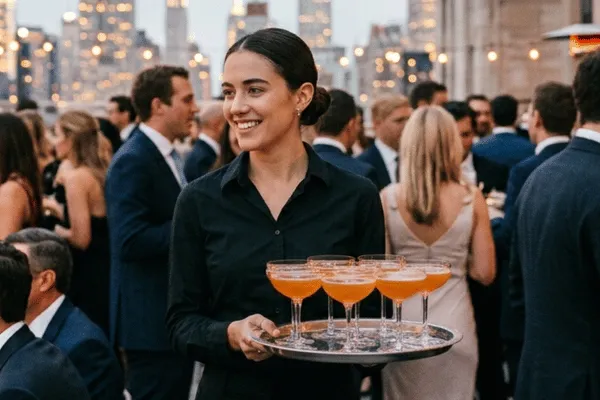
Signature Sip: The Paper Plane, September's Drink for Weddings and Corporate Events
September is the hinge of the event calendar.
The weather has not changed much yet. Guests still arrive in linen, cocktail hours still spill outdoors, and a warm evening in the first week of the month feels like an extension of August. But everything around the events has shifted. Clients are back at their desks. Calendars that were empty in July are suddenly stacked. The fall season is booked and moving, and by the end of the month the light will be arriving at a different angle.
The right drink for that month is one that can sit on both sides of it. Which is exactly what the Paper Plane was built to do, though not on purpose.
In 2008, Toby Maloney asked Sam Ross to create a drink for the opening menu at The Violet Hour in Chicago. He asked for a summer cocktail. Ross, then at Milk & Honey in New York, took the Last Word, a 1916 equal parts classic, as his template and swapped it down to the studs: bourbon for gin, lemon for lime, and two Italian bitter liqueurs in place of the Chartreuse and maraschino. What came back was bright and citrus forward enough for August and substantial enough for October. It went onto a summer menu and never left, and it is now one of the few genuinely modern classics, on bar menus from New York to Toronto to Melbourne.
For a September event, that dual character is the entire value. Serve it at a warm early month reception and it reads as the last bright drink of the season. Serve it at a fall gala three weeks later and it reads as the first serious one. Same four ingredients, no adjustment.
Ingredients (Per Serving)
Equal parts, three quarters of an ounce each:
0.75 oz bourbon
0.75 oz Aperol
0.75 oz Amaro Nonino Quintessentia
0.75 oz fresh lemon juice
Ice
That is the whole recipe. No syrup, no infusion, no prep beyond juicing lemons.
Why equal parts matters at an event. Ross designed this drink deliberately around four bottles a decent bar already has, with nothing to make in advance. For event service that is close to ideal. There is no syrup to run out of, no batch to spoil, and a bartender working fast at a crowded bar cannot easily get the ratio wrong, because the ratio is the same for everything. Very few cocktails this well regarded are also this forgiving.
On the bourbon. Ross has said the bourbon was always non negotiable. Reach for something at 90 proof or above. Below that the two amari overwhelm it and the drink goes flat and sweet in the middle.
On Aperol versus Campari. The original 2008 version used Campari, and Ross replaced it with Aperol shortly after to soften the bitterness. Aperol is the standard now and the right call for an event, where the room includes people who do not drink bitter cocktails on purpose. Campari is a legitimate variation if a client wants the drink drier and more aggressive, and some bartenders still prefer it.
On Amaro Nonino, and what it costs. An amaro is an Italian bitter herbal liqueur, the family Campari and Fernet belong to. Nonino is one of the gentlest of them, built on grape distillate rather than neutral spirit and tasting of orange peel, caramel, and a soft bitter finish, which is why it works in a drink meant for a whole room rather than a cocktail bar.
It is also the ingredient that makes this drink, and it is not cheap. A bottle runs well above what the other three do, which matters at a 200 guest bar. If the budget will not carry it, Amaro Montenegro is the closest widely available substitute and holds the shape of the drink. Averna and Meletti both work and both push it darker and sweeter. Any of these is an honest variation. None of them is a Paper Plane, and it is worth telling a client that plainly rather than quietly swapping and hoping.
How to Make It
Add all four ingredients to a shaker with ice.
Shake hard until the tin is properly cold, about twelve seconds. This drink is three ounces of undiluted liquid with nothing but lemon for balance, so the shake is doing real work.
Double strain into a chilled coupe.
Serve immediately.
Chill the glassware. A warm coupe kills this one faster than most, and the aromatics fall apart as it warms.
Garnishes
The Paper Plane traditionally has no garnish. Ross built it without one and most serious bars still serve it bare.
For event service, that is usually the wrong call, because a naked coupe on a tray reads as unfinished to a guest even when it is correct to a bartender.
Standard: A lemon twist, expressed over the surface and discarded or dropped. It sharpens the nose and costs nothing.
Elevated: A dehydrated orange or blood orange wheel laid flat on the surface. It picks up the Aperol, sits well against the amber color, and holds its shape for hours on a tray, which a fresh wheel does not.
For weddings: The coupe is already doing the work. Keep it to the twist and let the glass be the statement.
For corporate events: The dried wheel photographs better and survives a long reception, which matters when a drink is going to be carried around a room and put down repeatedly.
Scaling It for Your Event
Intimate gatherings (under 50 guests): Build and shake to order. Four bottles and a lemon press, no prep at all.
Mid size events (50 to 150 guests): Pre batch the four ingredients at equal ratio into service containers and refrigerate. Bartenders measure three ounces per drink, shake with ice, and strain. Juice the lemons the same day, since day old lemon juice noticeably dulls this drink.
Large events (150 plus): Same batching, plus two things. Keep coupes chilling in rotation rather than pulling them warm from a rack. And assign someone to lemon, because at volume citrus is the constraint on this drink and nothing else is. One person juicing steadily keeps a bar of any size moving.
For tray passed welcome drinks: Shake and strain in batches of six and send them out immediately. A Paper Plane sitting on a tray for ten minutes is a warm, flat version of itself.
The Non Alcoholic Version
Worth being honest about this one: three of the four ingredients are alcoholic, so the Paper Plane does not convert as cleanly as a lighter cocktail does. Anyone claiming an exact non alcoholic match is overselling it.
What does work is building toward the same shape rather than the same recipe. Equal parts of a non alcoholic bitter orange aperitif, strongly brewed and cooled black tea, and fresh lemon, with a dash of non alcoholic bitters. The tea is the important part, because it supplies the tannin and dry grip that the amaro was providing, and tannin is the thing missing from nearly every mocktail that tastes like juice.
Same coupe, same garnish, same color family. A guest holding one is holding a drink that belongs on the menu rather than an obvious substitute, which is the actual goal.
One Cocktail, Two Rooms
For September weddings, the Paper Plane works best as the cocktail hour headliner rather than the tray passed welcome drink. It is stronger than it tastes, three ounces of spirit and amaro with only lemon to soften it, and that is the right drink to walk up to a bar for and the wrong one to hand every guest twice in the first twenty minutes. Serve it in a coupe, keep the glassware cold, and it will be the drink people photograph.
For corporate events, it is close to perfect. It signals a bar that knows what it is doing without requiring anyone to explain it, it is fast to execute at volume, and it holds an audience that ranges from people who order Old Fashioneds to people who normally drink wine.
Ready to build a signature cocktail program for your September event? Our professional bartenders and mixologists handle everything from menu design through high volume service.
